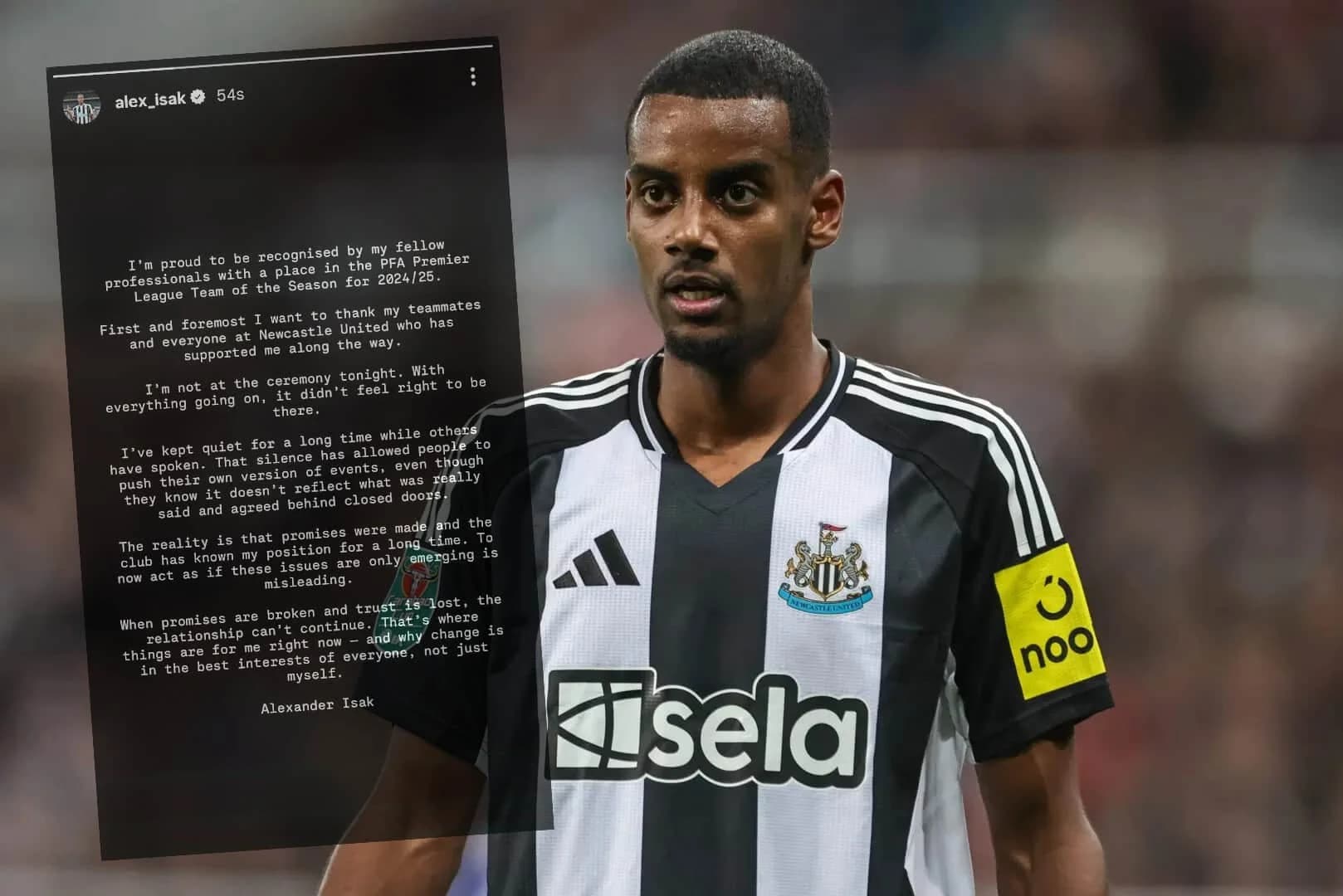
Football thrives on conflict, ambition, and broken hearts. Every summer the transfer market becomes a theatre of betrayal, loyalty, and business. But few sagas in recent years have embodied that drama quite like Alexander Isak’s current standoff with Newcastle United.
On one side stands Isak, Newcastle’s star striker, fresh off a brilliant season that earned him a spot in the PFA Premier League Team of the Year. On the other side stands Newcastle, a proud club trying to protect its project, its ambitions, and its financial footing. Between them hovers Liverpool, watching carefully, chequebook in hand, hoping to land a world-class striker.
But this isn’t just about Isak leaving or staying. It’s about broken promises, trust, player power, club responsibility, and the question of what loyalty really means in modern football.
So where did it all go wrong — and what happens next?
A Player Who Believes Promises Were Broken
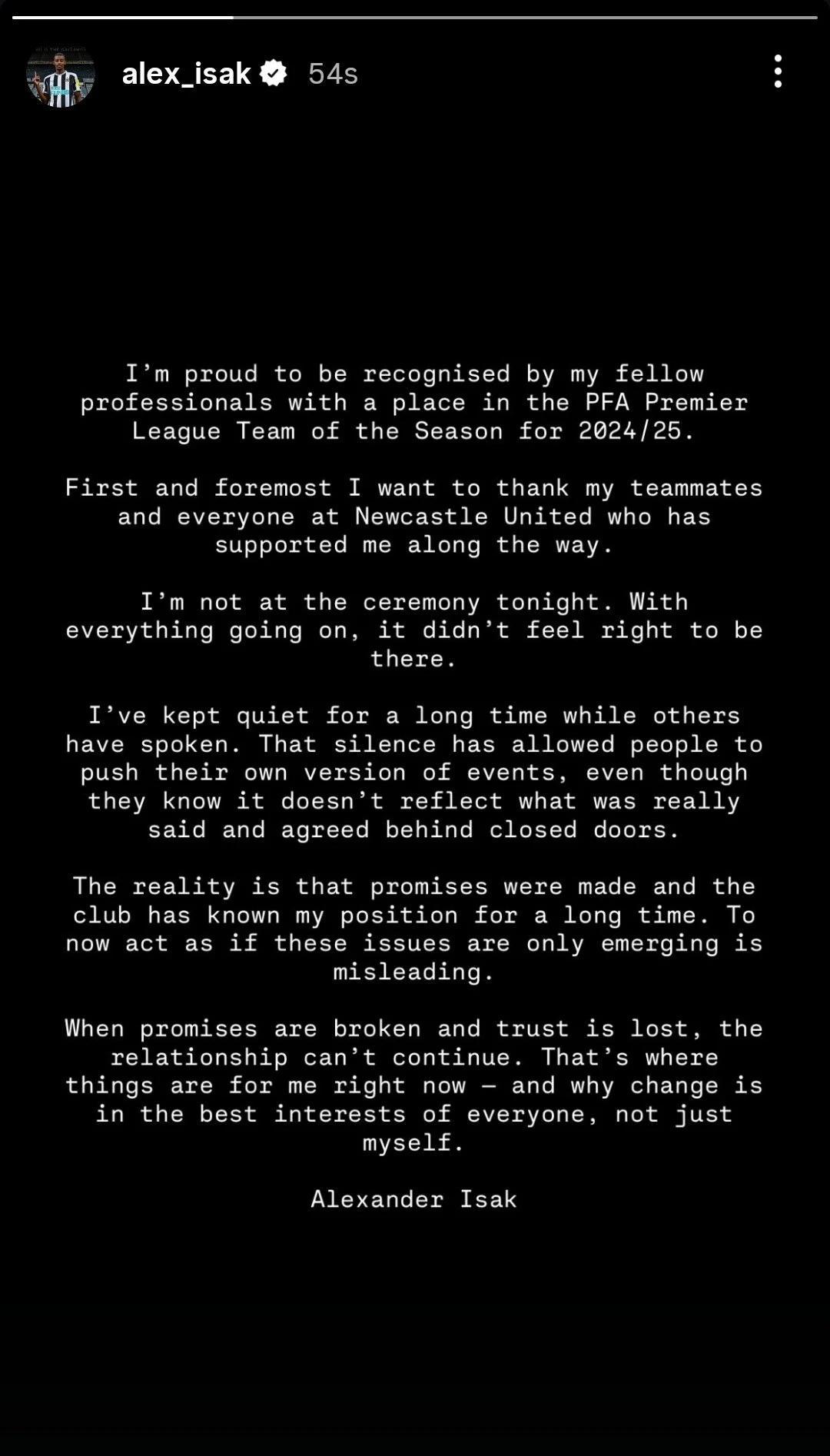
In his now-infamous Instagram statement, Isak made one thing clear: trust has been broken.
“When promises are broken and trust is lost, the relationship can’t continue.”
This wasn’t just a polite request for clarity. It was an outright declaration of dissatisfaction. Isak believes Newcastle made commitments — either verbally or formally — that he would be allowed to leave under certain conditions. Whether that was tied to Champions League qualification, contract negotiations, or personal assurances from the board remains unclear.
But from Isak’s perspective, Newcastle have gone back on their word. And he feels cornered.
Silence Turned to Frustration
Isak claimed he stayed silent for too long while others controlled the narrative. His words suggest he feels misrepresented by the club, by the press, and perhaps even by his own teammates.
He skipped the PFA awards ceremony, where he had every reason to celebrate his season. Instead, he issued a damning indictment of his relationship with Newcastle. That choice — to turn a personal honour into a public protest — speaks volumes about how strongly he feels.
A Career at a Crossroads
At 25, Isak is entering his prime. Strikers live off momentum, and every season matters. For him, Liverpool represents a chance to play at the very top level, surrounded by world-class talent, competing for trophies immediately.
Can he afford to wait another season at Newcastle, who look unlikely to seriously challenge Manchester City, Arsenal, or even Liverpool themselves? Or worse — can he afford to stay in a toxic environment where trust has eroded?
From Isak’s side, the argument is simple: Newcastle gave their word. They broke it. And for the sake of his career, he must move on.
A Club Protecting Its Future
Newcastle, for their part, hit back hard. In their official response, they called Isak’s statement “disappointing” and denied ever promising him a summer exit.
The Contract Argument
The club’s position is clear: Isak has a contract, and they expect him to honour it. Football clubs live in constant fear of losing their best assets, and in Newcastle’s case, Isak is arguably their crown jewel.
They’ve invested heavily in him since his move from Real Sociedad. They’ve built their attack around him. And now, when the project still feels incomplete, they’re expected to simply let him walk away?
From Newcastle’s perspective, this is about more than one player. It’s about setting a precedent. If they give in now, what does that say to Bruno Guimarães, Anthony Gordon, or other stars?
The Financial Angle
Liverpool reportedly bid £110 million, which Newcastle rejected. Rumours suggest their asking price is closer to £150 million. Is that excessive? Perhaps. But for Newcastle, it’s the only way to soften the blow of losing their star man.
Selling for less would not only weaken them on the pitch but also in negotiations with future players and clubs. Why should Newcastle — with wealthy Saudi ownership backing them — be bullied into selling on Liverpool’s terms?
Protecting the Club’s Image
Newcastle’s response also framed themselves as the wronged party: a proud, family-driven club accused of dishonesty by one of their own. In their statement, they reminded fans that Isak remains part of their “family” and would be welcomed back.
This was more than PR. It was a direct attempt to win the battle of perception. To make Isak look like the selfish one, while the club held the moral high ground.
The Temptation of Anfield
While Newcastle and Isak trade blows, Liverpool wait in the wings. For them, this situation is ideal — and dangerous.
Why Liverpool Want Him
Liverpool need a successor to Mohamed Salah’s talismanic influence. Darwin Núñez has been inconsistent. Cody Gakpo flashes brilliance but hasn’t cemented his role. Diogo Jota remains injury-prone.
Isak offers something different: elegance, pace, clinical finishing, and the ability to link play. He fits the profile of a Liverpool striker perfectly — and at 25, he’s both ready-made and future-proof.
For Jurgen Klopp’s eventual successor or whoever leads Liverpool forward, Isak could be the spearhead of a new dynasty.
The Risk Factor
But £150 million is a huge gamble. Is Isak proven enough to justify it? He’s brilliant, yes, but he’s not Erling Haaland. Injury records, form dips, and adaptation pressure are all risks Liverpool must weigh.
And there’s the political angle. Do they want to be seen as fuelling player rebellion? Signing a striker who just accused his current club of dishonesty could come with baggage.
Broken Promises or Misunderstood Negotiations?
The heart of this saga lies in one question: were promises actually made?
If Promises Were Made…
If Newcastle did, in fact, promise Isak an exit under certain conditions (for example, failure to reach Champions League football), then the player has every right to be furious. Football contracts aren’t just about written clauses; they’re about trust. If Newcastle shook his hand and assured him he could leave, reneging now damages their credibility permanently.
If Promises Were Not Made…
But if Newcastle are telling the truth — if no such commitments were made — then Isak’s actions look like player power at its most disruptive. In that case, he is undermining the club, his teammates, and even the fans by trying to force a move that simply doesn’t fit Newcastle’s interests.
Which side is telling the truth? Without full transparency, we may never know. But this uncertainty fuels the drama.
The Bigger Picture: Loyalty, Power, and Modern Football
This saga is not just about Isak and Newcastle. It’s about where football is heading.
Player Power
We’ve seen it before: Neymar forcing PSG’s hand, Harry Kane pushing Spurs, Cristiano Ronaldo burning bridges. Top players now hold enormous power, sometimes greater than the clubs themselves.
Is Isak the latest to wield that power — or the latest to overplay his hand?
Club Power
On the flip side, clubs also use players as assets. Promises are made, then broken. Contracts are extended, then sold. Clubs demand loyalty until a player loses form — then they’re discarded.
Isak’s case highlights that imbalance. Do clubs expect loyalty they themselves rarely provide?
The Fans’ Dilemma
And then there are the fans, who are left to pick sides. Should Newcastle fans back the club that represents them, even if it means ignoring a star player’s unhappiness? Or should they empathise with Isak, who just wants to achieve greatness?
The irony is that fans crave both loyalty and ambition. They want players to stay forever — but they also demand success, which often requires ruthless decisions.
The Legal Angle: FIFA’s Article 17 Looms
One under-discussed part of this story is FIFA’s Article 17. It allows players to terminate contracts under certain conditions, usually after a “protected period,” with limited compensation.
If this standoff continues, could Isak invoke Article 17? It would be a nuclear option — a legal loophole that could set football ablaze.
For Newcastle, that’s the nightmare scenario: losing their star for far less than market value. For Isak, it’s a last resort. For Liverpool, it’s potentially a golden opportunity.
What Happens Next? The Big Questions
- Will Newcastle Stand Firm?
Can they afford to keep an unhappy player, especially one willing to go public with grievances?
- Will Isak Push Harder?
Skipping training, refusing matches, or even legal action — is he willing to go that far?
- Will Liverpool Pay Up?
£150 million is staggering. But if they truly believe Isak is the missing piece, will they stretch?
- Will a Compromise Be Found?
Could an agreement be reached for next summer, with Isak staying one more year under clear terms?
Conclusion: A Saga Without Winners (Yet)
At its core, the Isak-Newcastle saga is about trust, ambition, and control.
Isak feels betrayed. Newcastle feel cornered. Liverpool feel hopeful. Fans feel conflicted. And the wider football world feels fascinated.
There are no easy answers. If Isak leaves, Newcastle lose their star and perhaps their credibility. If he stays, they risk a toxic dressing room and an unmotivated striker. If Liverpool pay the price, they might land a generational talent — or overpay disastrously.
The only certainty is that this story is not over. And like all great football dramas, it will likely be decided not in statements, but on the pitch — perhaps as soon as Newcastle’s next match… against Liverpool.